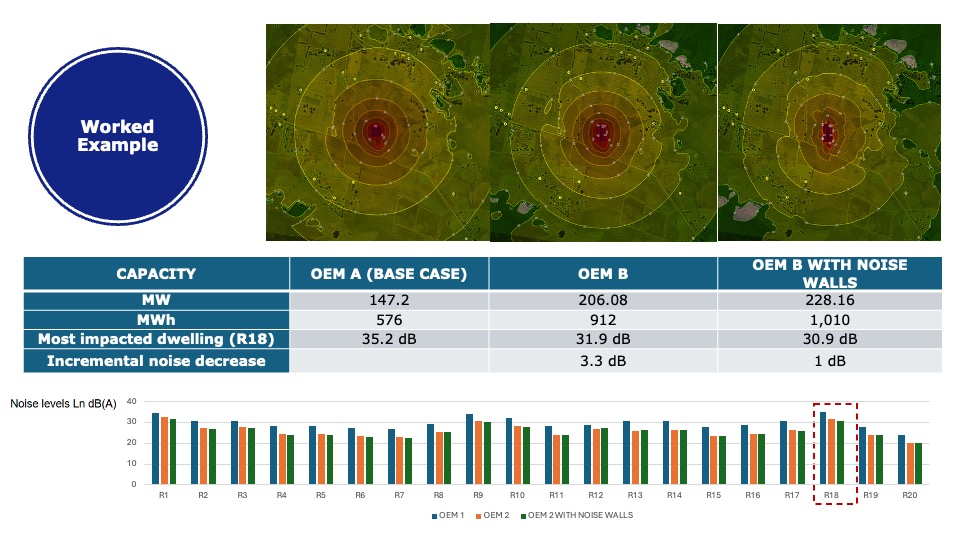
Introduction
What is responsible development?
For large scale clean energy infrastructure, it should mean locating and optimising projects to earn strong return for the developers and their shareholders while also ensuring the project works well for its land hosts, neighbours and local communities. This requires the impacts of the projects operation to be well understood and managed from the outset. The noise impacts of large scale battery projects are a great example.
Large-scale battery energy storage system (BESS) projects are increasingly essential to Australia's clean energy transition. Yet as the sector grows, developers are facing a practical and increasingly common challenge: how to maximise site capacity and commercial productivity while meeting planning requirements, protecting nearby residents and land hosts, and reducing environmental impacts - particularly operational noise from battery containers, inverters, transformers, cooling systems and associated electrical infrastructure.
At Enhar ReGen, we see this as a design optimisation challenge, not simply a compliance hurdle. Our utility-scale renewable energy and battery project services bring together land, planning, engineering, acoustic, environmental and commercial considerations early enough to influence the project outcome - before avoidable constraints become expensive redesign problems.
"Enhar resolves the tension between project disciplines – from chief financial officers to environmental officers - to achieve win-win outcomes for developers, land hosts, neighbours, communities and regulators. I am proud of the way our multidisciplinary team holistically integrates electrical, civil and acoustic optimisation, while also supporting revenue and financial model outcomes for our clients. This means we can originate, design and develop solutions that work well for developers and are received positively by neighbours and communities."
- Demian Natakhan, CEO, Enhar ReGen
These principles will be explored in more depth at Enhar ReGen’s upcoming responsible BESS conference, where developers, landowners, planners, consultants, regulators and industry partners will discuss how battery projects can be delivered with stronger community confidence, better design integration and more responsible development outcomes.
The problem: high-performing assets can be hard to fit into sensitive locations
For many projects, the best grid locations are not always located far from homes, rural dwellings or future sensitive receptors. Developers may secure land near strong grid network infrastructure, only to discover that population density means acoustic impacts, visual impacts, landowner preferences, civil constraints or planning authority expectations require a materially different approach. This is where early site origination and land acquisition strategy can be decisive.
The challenge is especially acute for BESS projects because sound energy can be concentrated in a relatively compact footprint. Inverters, transformers and battery cooling equipment may each be manageable in isolation, yet their combined contribution can create acoustic constraints at residences or other receptors. If this is discovered too late, projects can be pushed towards costly noise walls, reduced capacity, compromised equipment selection, difficult neighbour negotiations or delayed planning approvals.
The core question for developers is rarely just whether a project can meet a single technical threshold. It is whether the site can still support a strong commercial outcome while achieving BESS noise compliance in Australia, maintaining community acceptance and preserving a credible approval pathway.
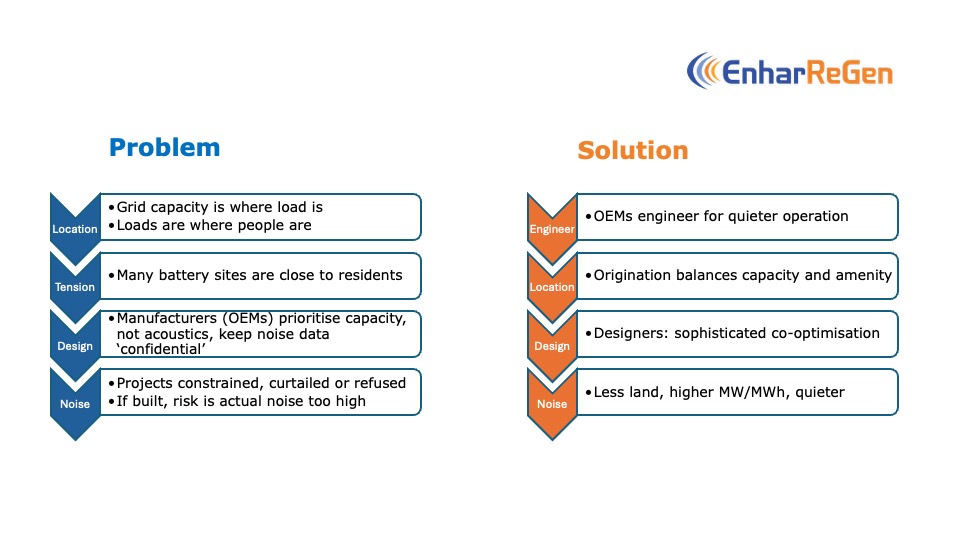
Our approach: optimise capacity, compliance and constructability together
Enhar's approach is to resolve these issues through integrated design thinking. Instead of treating acoustic compliance, electrical design, civil design, planning and financial yield as separate workstreams, we bring them together as connected project disciplines. Our noise-reduced layouts for BESS projects are designed to test practical battery site compliance solutions early: equipment orientation, inverter and transformer placement, separation to receptors, OEM noise characteristics, layout density, acoustic barrier implications, access, stormwater, earthworks and constructability.
This integrated method is important because a design change that helps acoustics may create electrical inefficiency, civil cost, operational access constraints or lost revenue. Equally, a layout that maximises megawatts and megawatt-hours on paper may not be approvable, buildable or socially acceptable. Enhar's value is in balancing these competing considerations so the project can progress with a stronger evidence base and a clearer development pathway.
Our team combines electrical and mechanical design knowledge, spatial modelling capability, environmental planning expertise and a deep understanding of noise mitigation strategies, including inverter noise reduction through equipment selection, orientation, separation and layout refinement. We use SoundPlan, the industry standard noise modelling software, alongside AutoCAD for design refinements. We work constructively with leading acoustic consultants so that preliminary design iterations can be validated through the appropriate technical acoustic assessments ready to submit to planning authorities, setting the accoustic performance standards which the operational project must adhere to. The objective is not only to make the numbers work; it is to create a project design that can be supported by landowners, neighbours, communities, regulators and investors.
Why early optimisation protects project value
Battery project developers are under pressure to move quickly. However, moving too quickly with an under-tested layout can embed risks that become expensive later. Enhar's early design optimisation helps clients identify whether a site can carry the intended capacity, whether sensitive receptors require a different arrangement, whether equipment selection matters to compliance, and whether the project is likely to remain constructable and commercially productive.
- Protecting capacity by testing design options before surrendering valuable generation or storage footprint.
- Reducing planning risk by aligning the concept design with battery project acoustic compliance, environmental and approval requirements.
- Improving constructability by considering civil, access, drainage, topography and operational requirements early.
- Supporting landowner and neighbour confidence through practical, respectful and evidence-based design responses.
- Avoiding costly late-stage redesign by resolving conflicts between project disciplines before they become critical.
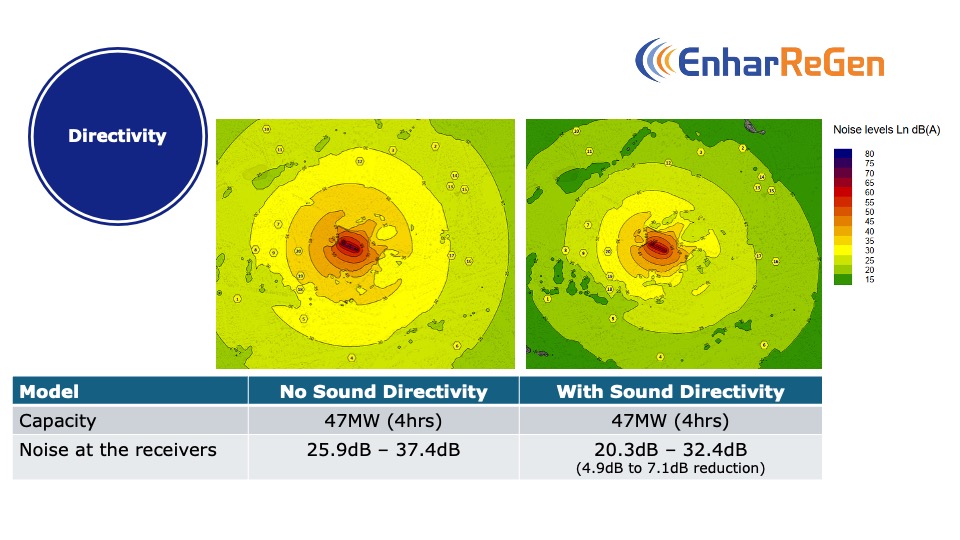
A team that understands technology and people
The strength of Enhar's delivery model is our multidisciplinary team. Our engineers, planners, GIS specialists, project managers and environmental advisors work across the full development lifecycle, from early site identification and landowner engagement through to concept design, approvals, specialist coordination and project delivery. This enables us to connect technical decisions with real-world consequences for communities and project hosts.
That perspective is central to Enhar ReGen's mission: to empower partnerships between developers, landowners, communities and regulators to scale up the renewable energy and storage industry responsibly. For us, landowners, neighbours and local communities are not peripheral stakeholders. They are central partners in the process. A successful project is not just one that reaches financial close; it is one that earns confidence, can be built, can operate responsibly and can make a long-term contribution to the energy transition.
From design tension to responsible project outcomes
The best battery projects are not created by optimising one discipline at the expense of another. They are created by resolving tensions between capacity, acoustics, land, planning, electrical design, civil design, constructability and commercial yield. Enhar's project management services for BESS and solar developments help maintain that joined-up thinking through the development pathway, so that project risks are identified early and managed in an orderly way.
For developers, this means a more resilient project. For land hosts and neighbours, it means a more considered project. For planning authorities, it means a clearer and more credible proposal. And for the renewable energy sector, it means battery infrastructure can scale in a way that is technically robust, commercially viable and socially responsible.
Enhar ReGen will also be continuing this conversation at its upcoming responsible BESS conference, bringing together industry participants to focus on practical pathways for responsible battery energy storage development in Australia.
If you are developing a large-scale BESS project and need to improve acoustic compliance, protect site capacity or resolve design constraints before approval, Enhar ReGen can help. Explore our utility services, including land acquisition, noise-reduced layouts and project management for renewable energy and storage projects across Australia.